
Obsessive-compulsive disorder (OCD) has a reputation for rituals: repeatedly checking that the stove is off, excessively washing hands and cleaning items, or aligning objects until they’re “just right.” But OCD is more than rechecking, redoing, and rearranging. Someone can look completely fine while spending hours caught in intrusive thoughts and compulsive responses that no one else can see.
“OCD is characterized by unwanted, intrusive thoughts, images, sensations, or urges, and compulsions are used to respond to the distress or uncertainty they create,” explains Maria Rheba Estante, LMFT, LPCC, a licensed marriage and family therapist in Honolulu who specializes in treating OCD. “And those compulsions can be completely covert when they happen mentally rather than behaviorally.”

During this OCD Awareness Month, we’re dispelling the myth that the disorder is just about cleaning or being meticulous. It’s a mental health disorder that can consume hours of a person’s day, cause significant distress, and interfere with responsibilities, relationships, and overall well-being.
“OCD isn’t a preference or a personality trait; it’s not perfection or being very particular,” says Estante. “It can be debilitating to a person’s quality of life.”
Cycle of uncertainty
Obsessions are unwanted and intrusive thoughts, images, sensations, or urges that repeatedly enter a person’s awareness and cause distress, uncertainty, disgust, guilt, or a sense that something is not right.
Compulsions are behaviors or mental acts a person feels driven to perform, often in an attempt to reduce distress, gain certainty, neutralize an intrusive thought, achieve a “just-right” feeling, or prevent a feared outcome.
OCD can take many forms and show up differently from person to person. Common themes include:
- Contamination and cleaning: A fear of germs or illness that drives compulsions like excessive handwashing, cleaning, or avoiding places.
- Symmetry and ordering: A need for things to feel “just right,” leading to compulsions like arranging, counting, or repeating actions until the feeling of incompleteness or wrongness subsides.
- Harm and checking: Intrusive fears of causing harm or being responsible for something bad, prompting repeated checking of locks and appliances, and seeking reassurance from others.
- Taboo or intrusive thoughts: Unwanted, distressing thoughts about violence, morality, or religion, often managed through mental rituals or avoidance.
Regardless of the theme, OCD thrives on uncertainty and doubt. A person may feel compelled to check or repeat a ritual to quiet the fear or provide a sense of resolution, but the relief is often temporary.
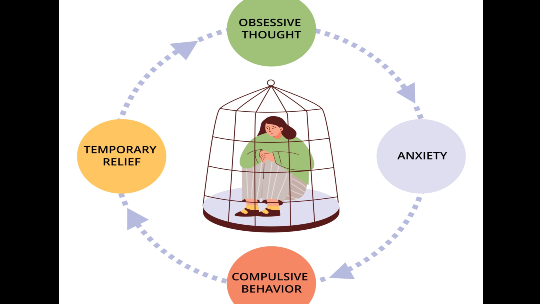
“The paradox is that compulsions may make someone feel better for a moment, but repeatedly relying on them can strengthen the OCD cycle,” says Estante. “The brain learns to keep treating the uncertainty or uncomfortable feeling as something that has to be solved.”
An invisible toll
Since OCD can play out internally, some compulsions may not be obvious. Avoidance is one that’s commonly overlooked. A person may avoid situations, people, memories, or activities because they trigger obsessions or uncomfortable uncertainty.
Mental compulsions can be equally consuming. A person may replay past conversations to make sure they didn’t say anything wrong or endlessly plan future interactions, mapping out every possible outcome. It’s also common to silently count in patterns, review events, or mentally neutralize one thought with another.
“They can appear fully present in a meeting or at a family dinner while performing mental rituals the entire time,” says Estante. “It can function like a second full-time job that no one sees.”
The weight of shame
OCD can stay hidden for another reason. Estante says because intrusive thoughts often center on a person's deepest fears, they can feel too frightening or embarrassing to share.
“OCD targets what you value most,” she explains.
That means someone who values integrity may be tormented by persistent guilt that they’re a bad person. A person with deep faith may experience intrusive thoughts of blasphemy. But Estante wants people struggling with OCD to keep three things in mind:
- Your OCD thoughts are not you.
- You don’t have to recover alone.
- Experiencing intrusive thoughts doesn’t make you a bad person.
“It’s not uncommon for people to hesitate to disclose their OCD symptoms because they fear being misunderstood, judged, or rejected,” she says. “Being able to describe what’s actually happening to a clinician who understands OCD can be an important step toward receiving appropriate treatment.”
Facing the fear
Treating OCD usually starts with Exposure and Response Prevention (ERP), a first-line, evidence-based therapy for OCD. In ERP, a therapist helps clients gradually face feared thoughts, images, situations, and uncertainty without performing their usual compulsions.

“The goal isn’t to guarantee that anxiety disappears,” explains Estante. “It’s to help the person discover that they can experience uncertainty, anxiety, or that ‘not right’ feeling without automatically performing a compulsion to make it go away.”
Over time, ERP can help weaken the learned connection between an obsession and the perceived need to ritualize.
“A thought can arrive, and the person can learn, ‘I don’t have to solve this. I can allow the uncertainty to be here and continue with my life,’” says Estante. “That’s a very different kind of freedom from trying to make every uncomfortable thought disappear.”
A different kind of support
Friends, family, and a strong support system can play an important role in recovery. Estante notes that supporting a person with OCD is different from accommodating the disorder.
Family accommodation can include participating in rituals, repeatedly providing reassurance, completing tasks for someone because OCD makes those tasks difficult, or reorganizing routines around OCD symptoms. These responses usually come from compassion and a genuine desire to relieve a loved one’s distress. But, like the compulsions themselves, accommodation teaches the brain that the fear was valid and the ritual was necessary.
“A helpful frame is to side with the person and against the OCD,” suggests Estante. “In practice, that can sound like, ‘I love you, and I’m not going to answer that question because we both know it’s the OCD asking. I’ll sit with you while it’s uncomfortable.’ That’s not withholding support but supporting recovery.”
Reclaiming time
OCD is treatable, and many people experience substantial improvement with specialized treatment. Recovery isn’t linear, and progress doesn’t require a person to never experience another intrusive thought. But signs of improvement include:
- Compulsions taking up less time and becoming easier to delay or resist.
- Recovery time after a symptom spike dropping from days to hours to minutes.
- Meeting a feared “what if?” with “maybe, maybe not.”
“One of the clearest indicators that treatment is working is when a person's life starts filling up with what they value instead of what they fear,” says Estante. “They reclaim their time not because the doubt disappeared but because it’s no longer in charge.”

Protect your mental health
Read the stories below to learn how to prioritize mental wellness: