Breathing is one of those things you’d think you mastered at birth. While your body does it automatically, experts say practicing conscious, controlled breathing, known as breathwork, can help calm your mind and body.
At a time when many of us are feeling overwhelmed by work, family responsibilities, financial pressures, and constant digital distractions, simple practices like breathwork may offer a way to slow down and reset.
Breathwork has been practiced for thousands of years. In ancient India, China, and Greece, people used it for many purposes, often viewing it as a mystical way to shift energy flow in the body, change mental states, or connect with a higher power. Today, researchers have a better understanding of how controlled breathing influences the nervous system and why it can promote feelings of calm.
The body’s response to stress
When someone is stressed, there are a number of physical reactions. This includes rapid breathing, increased heart rate, and tense muscles. This heightened state is known as the “fight or flight” (sympathetic) response. While this state is helpful in true emergencies, being in fight or flight repeatedly or for extended periods leads to chronic stress, which causes long-term damage to your physical and mental health.

Conscious, controlled breathing can help you focus and calm stressful moments.
Breathwork to calm the stress response
“Practicing breathwork begins with developing a greater awareness of how we breathe. We can unknowingly fall into patterns such as shallow breathing, breath holding, or breathing too quickly, especially when we’re stressed or intensely focused,” explains psychiatrist Chad Imanaka, M.D. “Breathwork gives us an opportunity to pause and notice these patterns. A conscious inhale followed by a slow, steady exhale can bring our awareness back into the present moment and interrupt our daily autopilot.”
Controlled breathing activates the rest and digest (parasympathetic) response, which can counter the body’s stress reaction. This part of the nervous system helps with recovery and relaxation. As breathing slows, heart rate slows as well, helping the body shift away from a heightened state of alertness.
“Our breathing and nervous system are closely interconnected,” Dr. Imanaka says. “We carry a tremendous number of mental and cognitive demands that can keep the fight or flight response switched on. A difficult email, traffic, financial worries, or persistent anxious thoughts can activate many of the same systems.”
Harmful effects of chronic stress
Serious health problems can occur when someone is under stress for prolonged periods. “The body can begin functioning as though danger is always nearby. This can contribute to a range of concerns, including disrupted sleep, fatigue, muscle tension, headaches, digestive symptoms, mood issues, irritability, anxiety, and difficulty concentrating,” explains Dr. Imanaka. “We also become disconnected from our intuitive awareness of our bodies because feeling tense or overwhelmed gradually begins to feel like our baseline level of ‘normal.’”

Role modeling breathwork can be helpful for kids to learn to calm down too.
Practice before you need it
Be sure to talk to your doctor before practicing breathwork, especially if you have lung disease, cardiovascular conditions, or anxiety disorders. Breathwork does not remove the source of stress or solve difficult situations, but it may help regulate the body's response to stress.
“Like any skill, the best time to begin practicing is before you need it most. I always tell my patients that breathwork is a practice, much like physical exercise. We don’t become stronger after exercising once, and we wouldn’t expect to prepare for a marathon by running only once. Breathwork works in much the same way,” says Dr. Imanaka. “We can’t expect to use it only during our most stressful moments and immediately experience its full benefits.”
Popular types of breathing techniques
Box breathing is a simple technique that uses equal counts of four seconds: inhale for four, hold for four, exhale for four, and hold again for four. It gives your mind and body a steady pattern to follow. Because it combines slow breathing with counting, box breathing can help lower stress, calm the mind, and improve focus. It may help move the body out of a stressed, high-alert state and into a calmer one.
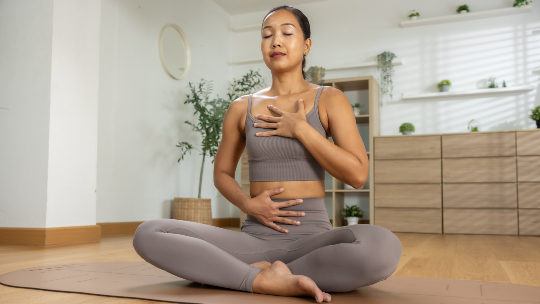
Diaphragmatic breathing expands and contracts your belly.
Diaphragmatic breathing focuses on using the diaphragm more effectively and can take some time to learn. Instead of breathing high in the chest, you breathe in a way that lets the belly rise while the upper chest stays relatively still. “Intentional diaphragmatic breathing, particularly slower, comfortable breathing with a gently extended exhale, can send the body signals of safety. This can support the parasympathetic nervous system,” says Dr. Imanaka.

Dr. Chad Imanaka
Learn more about health
Find more ways to deal with stress and how chronic stress affects your body: