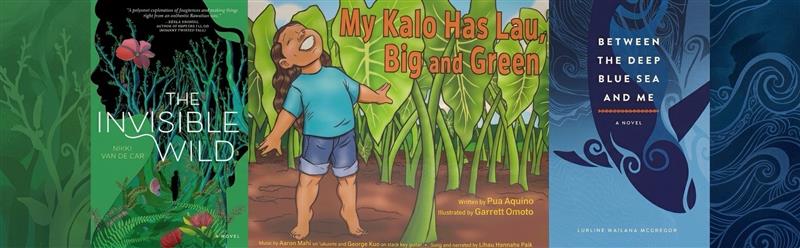
Good books can play an important role in our childhood. Stories spark imagination and help young readers explore and understand the world in magical ways. In our spring issue of Island Scene, our By the Book section highlighted books for keiki and young adults featured in Hawaii Public Radio’s Live from the Atherton: Author Series, stories that promote literacy, Native Hawaiian values, and health-focused family engagement.
This time, we’re going beyond the pages and getting to know the authors behind the books. We asked Lurline McGregor, Pua Aquino, and Nikki Van De Car about their creative process, inspiration, and their interests when they’re not writing. Discover the voices behind the books and learn how these local authors bring their stories to life.
Lurline McGregor, author of Between the Deep Blue Sea and Me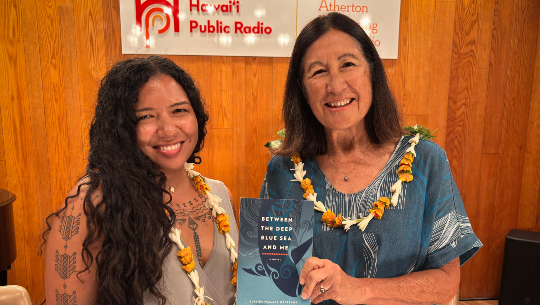
HPR Culture & Arts Reporter Cassie Ordonio with author Lurline McGregor at HPR’s Live from the Atherton. Photo courtesy Sylvia Flores
About Between the Deep Blue Sea and Me
Developers find a cultural artifact on land that has been in a family for generations. They donate the artifact to a museum, where anthropologist Moana Kawelo must make a difficult decision about where it belongs. Her work is guided by visions, dreams, and advice from a family friend. Waking in a Sea of Dreams, the recently released continuation of this story, delves further into Moana’s family secrets.
Can you share a little about yourself?
I was born in Honolulu to a Hawaiian-Chinese-Scottish father and German mother. I grew up in Honolulu with my parents, four brothers, two dogs, and many cousins. I went away to the Mainland for college and ended up staying there for the next 22 years. Before moving home, I lived in Washington, D.C., where I served as professional staff for Native Hawaiian issues on the Senate Select Committee on Indian Affairs, when Hawaii Sen. Daniel Inouye was chair of the committee. From this experience, I learned not only a great deal about the myriad of issues facing Native Hawaiians but I also learned to write.
After coming home to Hawaii, I worked as a producer for a local television magazine show and produced several of my own documentaries. The movie Whale Rider inspired me to make a feature film about my own Native Hawaiian community. I turned the movie script that I wrote into my first fiction book, Between the Deep Blue Sea and Me.
What’s your writing process like?
I first need to get inspired before I write, whether it’s articles for magazines or literature! When I say inspired, I start with a sense of the story I want to tell, even if I haven’t necessarily figured out how it ends. When I get stuck on something and don’t know what comes next, I go back and do more research. I like to have a lot of context for whatever I write, not only so I can better understand what I’m writing, but also so I can explain it.
What inspired your latest book?
After I wrote Between the Deep Blue Sea and Me, I realized this needed to be a trilogy and that the father of the protagonist's story was next. I started out thinking that his story would begin with his birth in 1942, but soon realized it had to start at the beginning of time.
Knowing nothing about very early Hawaiian history, I put the manuscript aside and spent two years researching, reading everything I could find, and talking to as many cultural experts as I could. The knowledge and insights I gained from this research journey were a real gift and critical in shaping my story.
What do you hope young readers will feel when they read your book?
I hope I can tell a story that young readers, especially in Hawaii, can relate to, regardless of whatever knowledge and life level they’re at. I hope they find the story interesting enough to read the whole book and learn something about Hawaiian culture.
What might surprise readers to learn about you outside of writing?
When I’m not writing, I’m usually out paddling, either in a six-person or my one-person canoe!
Pua Aquino, author of My Kalo Has Lau, Big and Green
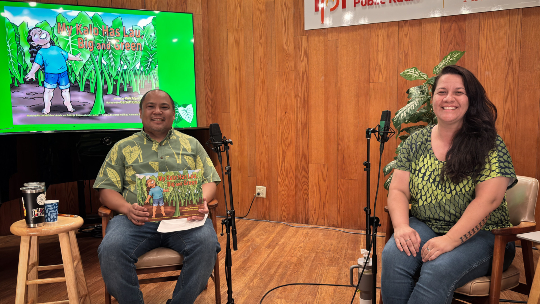
HPR Managing Editor Jason Ubay with author Pua Aquino at HPR’s Live from the Atherton. Photo courtesy Sylvia Flores
About My Kalo Has Lau, Big and Green
Have you ever wondered how kalo becomes poi? This children’s book guides readers through the process of turning kalo from a loi into poi, using both Hawaiian and English. It also includes keiki-friendly activities and a link to download read-along, sing-along, and instrumental tracks. You can read the story or sing it, making the experience fun and engaging.
Can you share a little about yourself?
I was born and raised in Makaha and still live on the leeward side of Oahu. I never imagined I would become an author. At the time, I was developing curriculum for Ka Paalana Homeless Family Education Program and was trying to find a developmentally appropriate way to teach families about kalo, pai ai, and poi. Writing a children’s story felt like a natural way to share that knowledge in a way that was engaging and accessible. What started as a curriculum idea for Ka Paalana slowly turned into a children's book published through Partners in Development Foundation (PIDF).
What is your writing process like?
My Kalo Has Lau, Big and Green was the first book I ever wrote, so I didn’t really have a set writing process. Because of my background in early childhood education, I knew I wanted the text to have rhythm and flow. I’ve always loved the cadence in Anna Dewdney’s Llama Llama Red Pajama. In early childhood, rhyme and repetition help children stay engaged and support comprehension. Once the words started to rhyme and flow naturally, it actually became easy to turn the story into a song, making it even more fun and interactive for young learners.
What inspired your latest book?
While working as a curriculum specialist with Ka Paalana, a program of PIDF, I created several lesson plans centered around kalo. When I first learned how to pound kalo, I discovered there’s a stage between cooked, kalo paa, and poi. That stage is called pai ai, which simply means “pounded food.” Once you add water to pai ai to make it smoother, it becomes poi. I realized many families didn’t know about that step in the process, and I wanted to create a story that made learning about it simple, joyful, and culturally grounded.
What do you hope for young readers to feel when they read your book?
I hope readers walk away feeling a little more connected and a little more knowledgeable. I want them to understand the journey kalo takes before it becomes poi and to learn a few Hawaiian words along the way. Most of all, I hope the story brings them joy and maybe even inspires conversations at home about kalo and olelo Hawaii.
What might surprise readers to learn about you outside of writing?
People might be surprised to hear that I didn’t enjoy reading when I was in school. From elementary through high school, I mostly read only what was required. It wasn’t until after I graduated that I began exploring topics I was truly interested in — Hawaiian culture, early childhood education, and curriculum development. As an adult, I discovered how powerful reading can be in expanding your knowledge and deepening your understanding. That shift really shaped both my career and my journey into writing.
Nikki Van De Car, author of The Invisible Wild
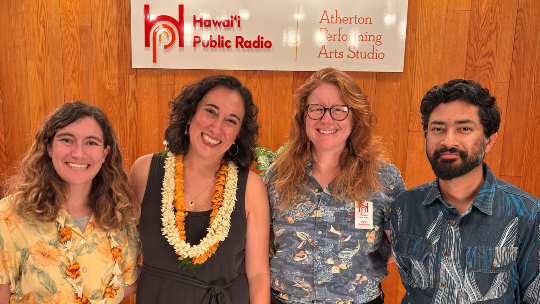
HPR Executive Producer for The Conversation Maddie Bender with author Nikki Van De Car and Kyla Herrmann, Ananddev Banerjee at HPR's Live from the Atherton. Photo courtesy Sylvia Flores
About The Invisible Wild
According to legend, when the kanaka oiwi sailed over 2,000 miles across untraveled seas to the most remote island chain in the world, they encountered the menehune. They were 2- to 3-feet tall, good and kind, and bothered no one without cause. The menehune chieftains feared change the Hawaiian’s brought and ordered all men and their firstborn sons to leave Hawaii. Some refused and, instead, stayed behind with their families.
Fast forward to today: 16-year-old Emma comes across a boy from Hilo living in the woods, saying things that do not make sense. In these woods, Emma has memories of finding a space between “the worlds.” Together, Emma and the Hilo boy must figure out what the menehune want before it’s too late to save the only home any of them have known.
Can you share a little about yourself?
I live in Volcano on the Big Island, where I was born and raised. I think I always wanted to be a writer – I was always telling stories in my head, playing pretend. I didn’t know if I would end up doing that for work, but I always had the sense that storytelling would be part of my life.
What is your writing process like?
First, I start with the seed of an idea. Like, what if the things we think are real aren’t real? What if The Secret Garden was evil? What if all the polytheistic gods vanished? And then I play around with that for a while, which can look nothing like writing. I leave myself voice notes while driving, make playlists, or make Pinterest boards.
And then once I have a real sense of the vibe I’m going for and who the characters are, I start outlining. I love knowing where the story is going, and I want readers to be able to rely on the fact that I know! I want every part of my story to feel intentional. And then once I have a solid outline, I'll finally start drafting!
What inspired your latest book?
Well, as a matter of fact, I’m working on a Gothic reimagining of The Secret Garden! I loved that book as a child, but I wondered what it might be like to view the garden less as a sanctuary/place of healing, and more as something that serves as a metaphor for the ways we can hide something terrible by making it beautiful.
What do you hope for young readers to feel when they read your book?
When I wrote The Invisible Wild, I wanted to write a love letter to my home here in Hawaii, but also to myself as a child who felt like she didn't belong. I want young readers here and everywhere – because the need for belonging is universal – to understand that there’s no right way to be the person you are. We all just do our best, and that is more than enough.
What might surprise readers to learn about you outside of writing?
I'm a knitter and handspinner! I learned when I was living in Minnesota, but it’s so cold in Volcano that I'm always making sweaters, blankets, and scarves for myself, my friends, and my family. I love being cozy.
Live From the Atherton is Hawaii Public Radio’s new flagship event series, featuring music performances, authors and other creative, original thinkers in HPR’s Atherton Studio in Honolulu. Hawaii Public Radio’s Live from the Atherton is proudly sponsored by HMSA.
Continue your book reading journey
Explore more articles about books, authors, and the joy of reading.
- 3 easy ways to read more books
- 3 tips for reading with your keiki
- 5 ways reading improves your well-being
- bamboo ridge presses on with hawaii stories
- books for happiness
- libraries: an all-access pass to the world
- local comic book heroes
- the art of enchantment
HMSA has respectfully removed all diacritical markings from this article for formatting purposes.


.jpg)