Jessica Munoz, a nurse practitioner, recognized a disturbing pattern as children came into the ER. “They were being labeled as delinquents, truants, or runaways,” she says. “But they were children being trafficked, right here in Hawaii. I saw kids as young as 11 getting arrested for prostitution.”
Twenty-three percent of victims are sex trafficked before the age of 18, according to the Hawaii Department of Human Services. Of those under 18, the average age at which a child is first sexually exploited or trafficked in Hawaii is 11. Sixty-four percent of victims are Native Hawaiian.
“I knew we needed to intervene, protect these kids, and create a space for long-term healing,” says Munoz, founder of Hoola Na Pua, the nonprofit that operates Pearl Haven, the state’s first-of-its-kind specialized residential treatment facility.
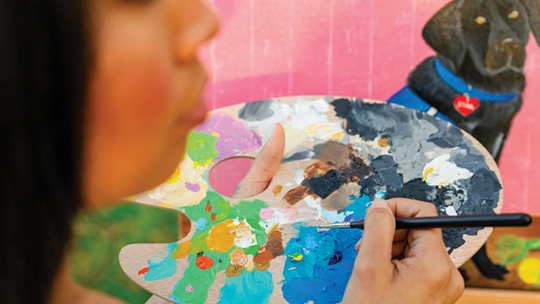
On the rural 12-acre campus on Oahu, young survivors of sexual exploitation are finding safety, rediscovering their identities, and reclaiming their childhoods and futures. They’re healing in a tranquil environment that’s grounded in nature and carefully designed to support their recovery: soft pastel-painted walls in classrooms and bedrooms, a movement studio for dance and yoga, and a serenity garden where they grow their own food. In this home away from home, they’re learning how to feel safe in their own bodies and the world again.
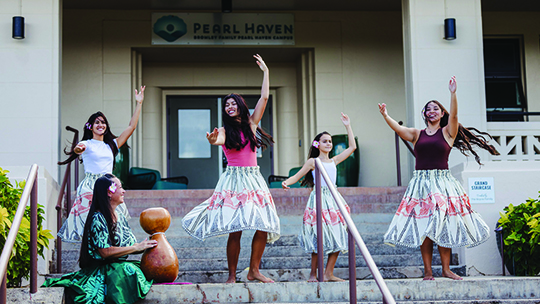
Healing through hula. Photo courtesy Pearl Haven
“Before coming to us, some girls couldn’t be placed in foster homes because of aggression, substance use, or self-harm,” says Elizabeth Kuupuamailani Porter, Pearl Haven program director. “This wasn’t bad behavior; it was how they knew to cope. Now, they’re learning new ways here.”
From the moment the girls wake up at 6:30 a.m. until bedtime around 9 p.m., their days are filled with intention. They attend school on campus, where classes are interspersed with talk therapy, mindful movement, culinary arts, and equine and surf therapy.
“Many survivors bury trauma as a survival technique,” explains Munoz. “These experiential therapies allow them to release it and build self-esteem by trying new things.”
Restoring self-worth and a sense of self also comes from returning to their roots. The girls learn about their Native Hawaiian culture through hula, music, and Olelo Hawaii.
“Reclaiming that identity is part of reclaiming themselves,” says Porter. “They’re relearning who they are beneath the trauma and finding a sense of belonging.”
Healing is hard, and it isn’t linear. But there are wins every day: a girl struggling with self-harm who chooses to reach out to a staff member instead of acting on this impulse, or a girl previously closed off but becomes excited to talk to others at lunch.
“It’s those little moments that keep us all going,” says Porter. “That’s the hope. That’s the light.”
Over the course of the nine-month treatment program, those small moments build and the girls’ confidence grows, while their trauma symptoms decrease. They foster connections and develop healthy stress responses, overcoming their previous coping skills.
“So many of our kids are breaking generations of trauma, abuse, and violence,” says Munoz. “They’re the ones shifting the trajectory of their lives.”
Since Pearl Haven opened in 2021, more than 100 youth have found safety, care, and trust. A girl who only wanted to get her GED before Pearl Haven is now an honors student at the University of Hawaii at Manoa. Another girl who once skipped school every day is now keeping her GPA up and able to play on her school’s sports team. They’re returning to their communities with a stronger sense of self and possibility.
“Healing is a lifelong journey. We won’t be able to get them to the finish line, but we’re helping them get farther along on that path,” says Porter. “Because the trauma doesn’t define them. It becomes part of their story, but it’s not the end.”
Learn more at pearlhavenhawaii.org or hoolanapua.org.
Hero and thumbnail illustration by Garry Ono
SU26F